Research
Chemistry of Icy Molecules in Protoplanetary Disks
Molecular line observations have revealed the wealth of chemistry in the cold disk gas, while the ice chemistry remains elusive. To study the chemical composition and evolution of ice in disks, we focused on disks around stars undergoing episodic accretion bursts, where ices have sublimated from dust grains due to the elevated temperatures. With ALMA Band 3 observations, we detected various complex organic molecules (COMs) in the disk around the Class I outbursting protostar V883 Ori. We discovered that the abundance ratios of COMs relative to methanol (CH3OH) are higher than the protostellar values and that COMs are enriched in 13C (12C/13C ≈ 23) compared with the canonical ratio in the local interstellar medium (≈ 69). This study demonstrates that chemical evolution in disks may play a pivotal role in determining the composition of gas and ice available for planet formation.
Paper: Yamato et al. 2024a, AJ, 167, 66. This paper was highlighted in NRAO eNews in connection with the ngVLA.
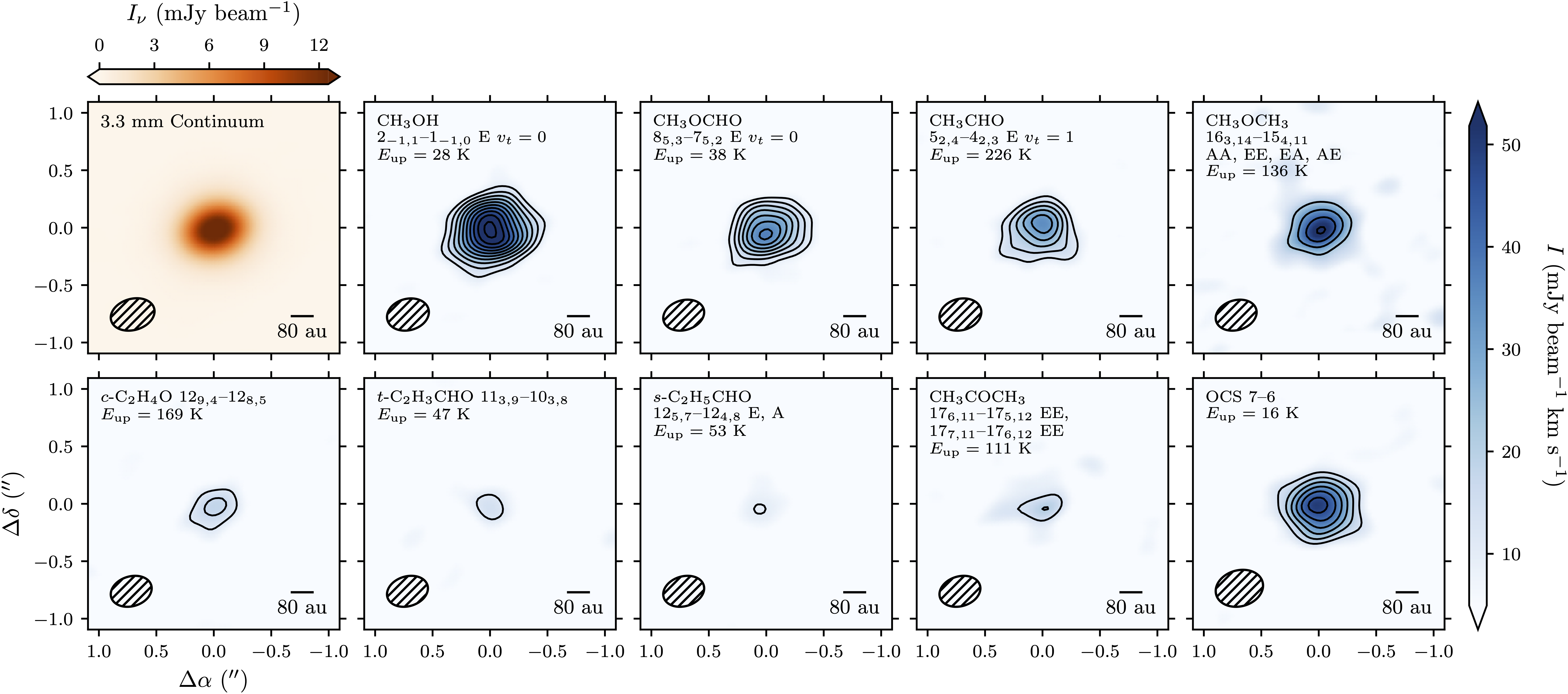
We also successfully detected the COM dimethyl ether (CH3OCH3) in a “normal” disk that is not undergoing an accretion burst but surrounds a relatively massive star—a Herbig Ae star with a mass of a few M⊙. The abundance of CH3OCH3 relative to CH3OH is significantly higher than the protostellar values, again indicating additional formation of COMs during the disk phase.
Paper: Yamato et al. 2024b, ApJ, 974, 83
Sulfur-bearing icy molecules are also present in the gas phase in the innermost regions of protoplanetary disks. We detected compact emission of hydrogen sulfide (H2S), sulfur monoxide (SO), and sulfur dioxide (SO2) in the central region of the disk around HD 163296. Based on their broad line profiles, they likely arise from the innermost few au, where icy molecules have sublimated from dust grains. This indicates that these molecules can serve as useful tracers of the innermost regions of protoplanetary disks, where many (exo)planets are expected to form, as also suggested by our previous work (Yamato et al. 2023).
Paper: Yamato et al. 2026, ApJ, 1003, 64
Nitrogen Chemistry in Protostellar Disks as Traced by Ammonia Emission Lines
Nitrogen is one of the essential elements for the emergence of life on planets, yet its chemical behavior in planet-forming environments remains elusive because of observational challenges. The VLA is the only facility capable of observing, at high spatial resolution, a suite of transitions of ammonia (NH3), one of the major molecular carriers of nitrogen. We observed multiple transitions of NH3 and its deuterated isotopologue NH2D with the VLA toward the warm inner envelopes of protostars, where ices have sublimated. We found a high NH2D/NH3 ratio of approximately 0.1–1, suggesting that at least some NH3 ice formed during the cold prestellar stage and was subsequently delivered to planet-forming environments. This result is also consistent with chemical models predicting that the surface layers of ice mantles may contain deuterium-rich NH3 ice. Isotopic ratios of NH3 therefore provide valuable insight into nitrogen chemistry during star and planet formation.
Paper: Yamato et al. 2022, ApJ, 941, 75
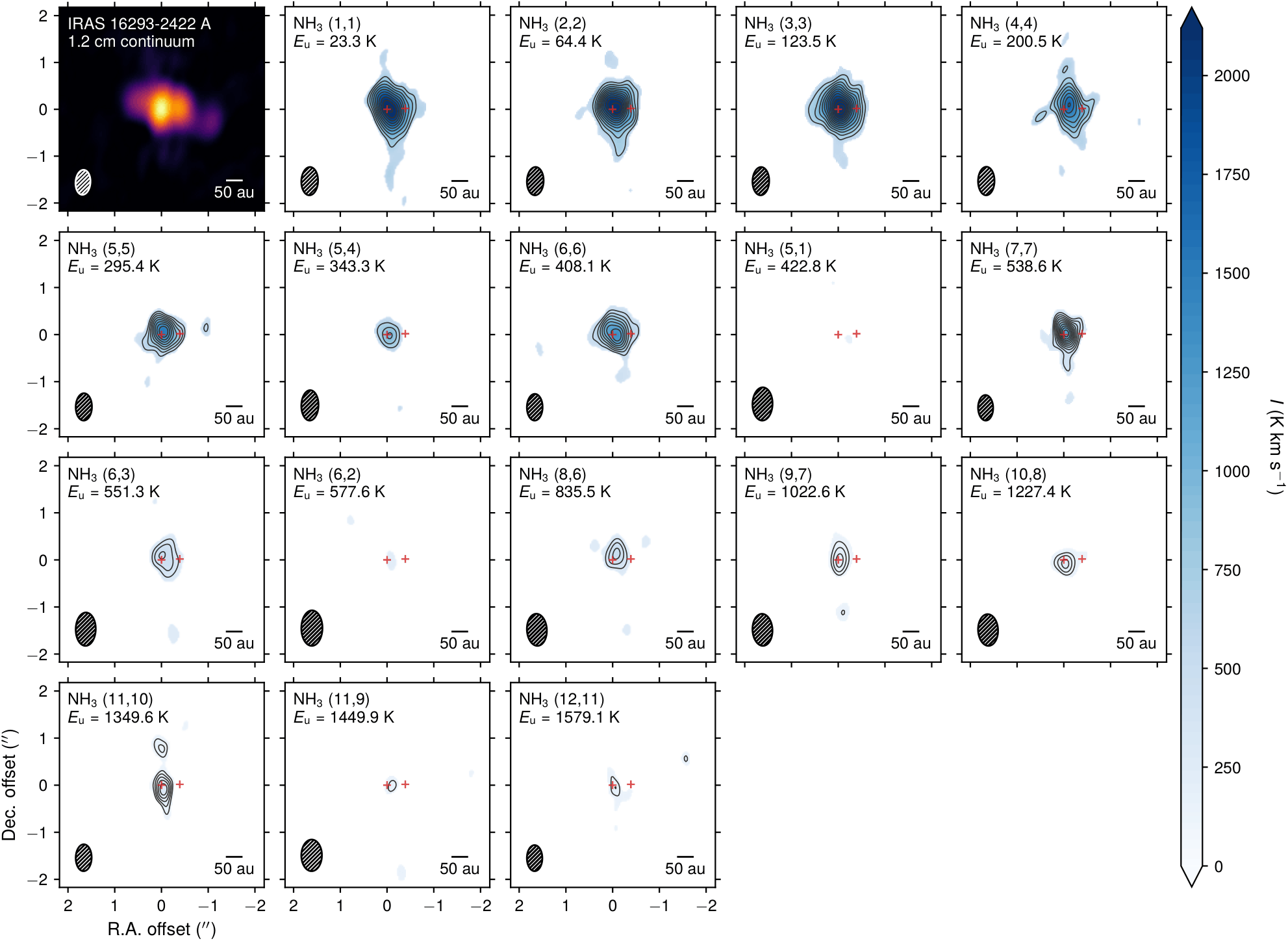
We extended this study to another bright protostellar source, IRAS 16293-2422, where we observed a more comprehensive set of 17 NH3 transitions at higher spatial resolution. These observations allowed us to better constrain the physical and chemical origins of the NH3 emission. In one of the binary components, IRAS 16293-2422 A, we identified warm (approximately 110 K) and hot (approximately 300 K) NH3 gas components. The hot component shows a remarkable spatial correspondence with a compact, shock-heated region revealed by high-resolution ALMA observations. The column density of this NH3 component is remarkably high and may be related to the sublimation or destruction of semirefractory nitrogen-bearing materials, such as ammonium salts and carbonaceous grains. This study provides an important basis for future investigations of these relatively nonvolatile nitrogen reservoirs, which may be key to understanding the origin of nitrogen in the Solar System.
Paper: Yamato et al. 2026, ApJ, 1005, 193